
A New Shield for Housebuilders? Why Aabar v Glencore Matters to Your Land Team
In the world of strategic land and development, information is our most valuable currency and often our biggest liability.
If you are a Housebuilder, Developer or Land Director the recent Court of Appeal developments in Aabar Holdings SARL v Glencore PLC is worth a “wait what?” moment.
For years, there has been a lingering grey area regarding how “private” your internal legal discussions actually are.
On 16 April 2026, the High Court handed down its latest decision in the FSMA claims against Glencore, Aabar Holdings S.A.R.L. & Others v Glencore Plc & Others [2026] EWHC 877 (Comm) clearing the air and it is a considerable win for corporate confidentiality.
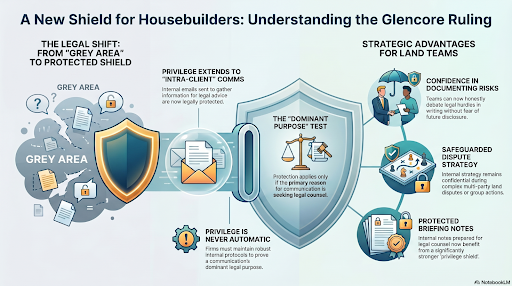
Whether protection from shareholder’s prying eyes or internal pre-lawyer legal privilege checks by an internal planning, land or sales manager, the Glencore decision clarifies that Legal Advice Privilege now extends to “intra-client” communications. If the dominant purpose of that internal email was to gather information or discuss a matter to get legal advice. That correspondence is now protected.
What does this mean for your Land Team?
- Confidence in Communication: Your team can now document internal risks and prepare briefing notes for legal counsel with a much stronger “privilege shield.”
- Strategic Advantage: In complex multi-party land disputes or “group action” scenarios (which are becoming more common in the sector), your internal strategy remains yours and yours alone.
- Better Risk Management: You can have more honest, written internal debates about legal hurdles without the fear that every sentence will be picked apart by a claimant’s solicitor two years down the line.
It is worth remembering, privilege is never “automatic.” Your internal processes still need to be robust. You must be able to prove that the dominant purpose of the communication was to obtain legal advice.
This is a significant shift that brings some much-needed certainty to the industry. Perhaps time to review your internal communication protocols and make sure your team knows exactly how to use this new precedent to protect your business?